Businesses migrate from Drupal to Webflow to escape heavy maintenance costs, eliminate developer bottlenecks, and speed up marketing. While Drupal offers deep enterprise data architecture, it requires constant security patching, module updates, and specialized developer support. Webflow provides a visual, all-in-one SaaS platform with built-in hosting and automatic updates.
The migration carries huge risk for your marketing if not done properly. Choosing the wrong agency is often what causes a migration to fail, not the platform switch itself. When rankings drop, traffic disappears, and business continuity takes a hit, it is usually because of who ran the migration and how. SEO, traffic, and site uptime are all on the line.
This guide covers:
- Why businesses are moving from Drupal to Webflow in 2026
- The best Drupal to Webflow migration agencies, compared on process, SEO capability, and post-launch support
- How to protect your rankings through a migration
- How to evaluate and choose the right partner
It compares the top agencies, walks through what a professional migration looks like step by step, and helps you make the right call with confidence.
Why companies move from Drupal to Webflow
1. Reduce maintenance and improve performance
Drupal's maintenance demands are relentless. Core patches, module updates, and version upgrades run on separate cycles and all require developer time. Drupal Version 7, which still accounts for 30.0% of all Drupal installs as of July 2026 reached end of life in January 2025.
It no longer receives community security updates. A highly critical Drupal core vulnerability was disclosed in May 2026. The security team warned that exploits could appear within hours or days. Webflow handles hosting, security, and platform updates with zero maintenance overhead passed to your team.
2. Give marketing teams more control
On Drupal, creating a new page, changing navigation, or updating a layout typically means filing a developer ticket. Webflow's Editor lets non-technical marketing teams publish pages, update CMS content, and launch campaigns without a developer in the loop.
Teams that move to Webflow report shipping landing pages and campaigns five to 10 times faster than on developer-dependent platforms.
3. Build a website that scales
As of July 2026, Drupal accounts for just 1.0% of websites with a known CMS and 0.7% of all websites. Webflow is already at 1.2% of known-CMS sites and growing steadily in the B2B SaaS segment. Version fragmentation makes the Drupal picture harder: Drupal Version 10 accounts for 31.4% of installs and Version 7 for 30.0%, meaning a large portion of the install base is either on an end-of-life version or still working through costly upgrades.
Webflow's CMS supports custom collection structures, multi-reference fields, and programmatic SEO pages that marketing teams manage without a single developer ticket.
Comparing Drupal vs Webflow at a glance
This table is a decision aid, not a feature list. Each row is designed to answer one question: does this matter to my business?
Companies with in-house Drupal development teams, complex governance structures, or tightly coupled legacy backend systems may be better served staying on Drupal. Companies where marketing files tickets to update the homepage, where version upgrade costs are hard to justify, or where the website is a core growth asset that needs to move fast, are the clearest candidates for Webflow.
3 best Drupal to Webflow migration agencies
1. Lil Big Things
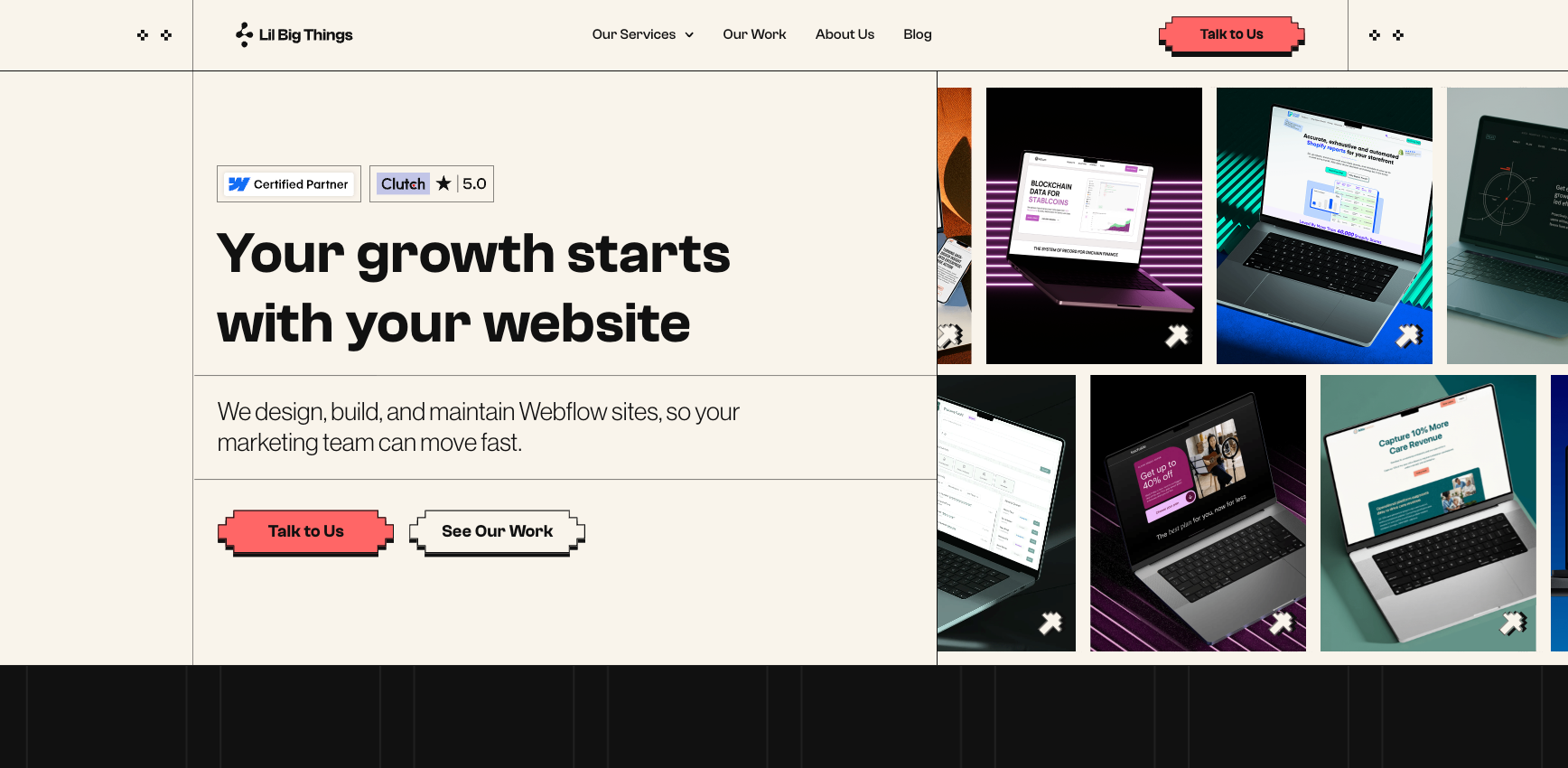
Lil Big Things is a Premier Verified Webflow agency for B2B startups and scaleups. Since 2021, the team has shipped 150+ sites with a 95% on-time delivery rate and a 9.2+ NPS from clients across four continents. Named a Top Agency for Spring 2026 by 50Pros, LBT holds Webflow's highest certification tier.
Migration expertise: End-to-end migrations covering site audit, CMS schema design (mapping Drupal content types to Webflow Collections), redirect mapping, metadata transfer, integration wiring (HubSpot, GA4, Salesforce), and post-launch SEO monitoring.
Best suited for: B2B SaaS, MarTech, AI, Data, HealthTech, and FinTech companies from Seed through Series C with marketing teams of two to 15.
SEO capabilities: Full Screaming Frog crawl before the build starts. Exact metadata transfer from Drupal's Metatag module. Schema setup via custom code embeds. Google Search Console monitoring daily for 14 days post-launch. SEO is baked in from day one.
Notable strengths: Every CMS architecture decision is built around one question: can the marketing team operate this independently after launch? The embedded team model means LBT is in Slack, working in client tools, aligned to client timelines. Post-launch support is built in, not billed separately.
2. BROWORKS
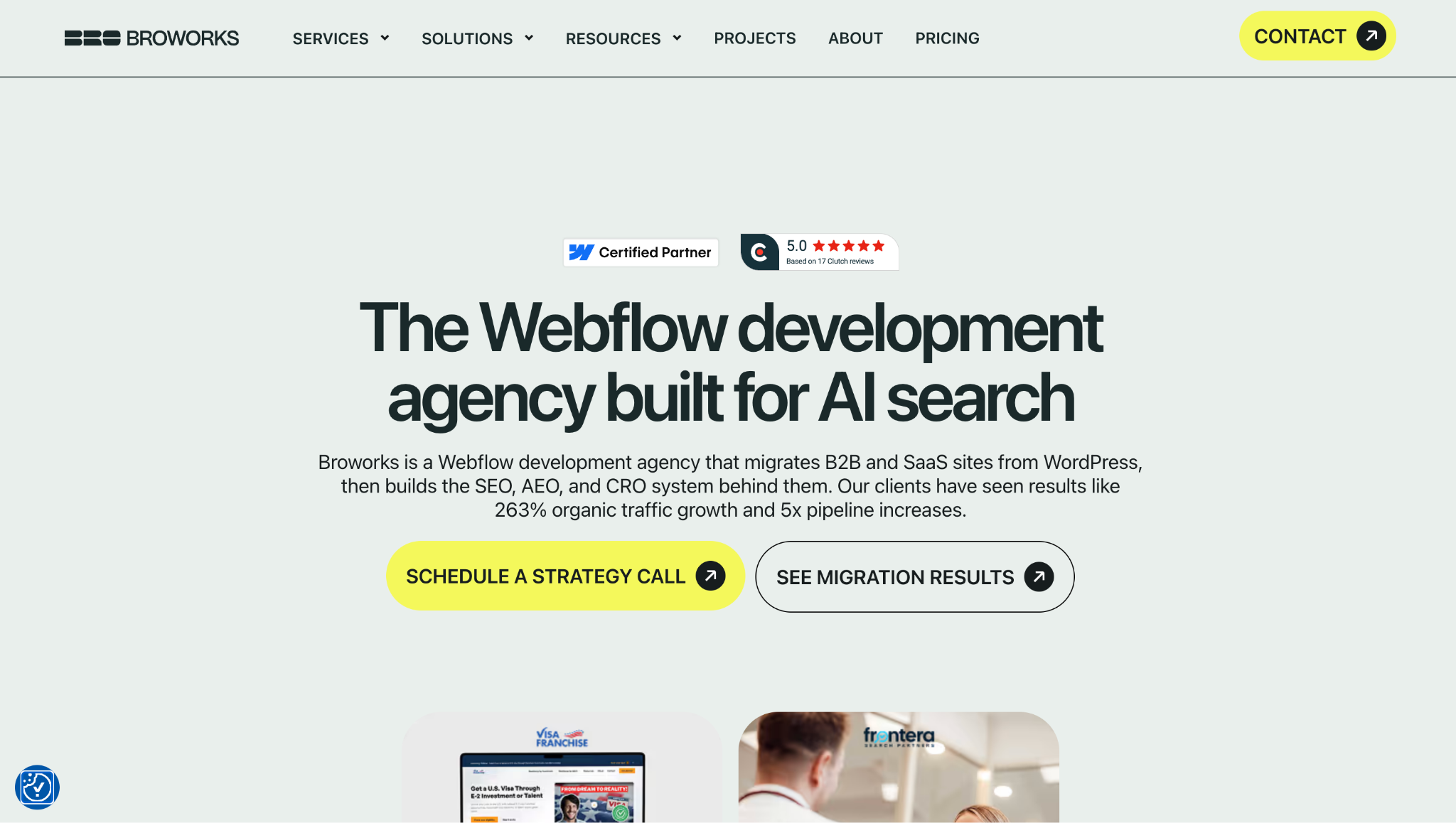
BROWORKS is a certified Webflow agency founded in 2019, serving B2B, SaaS, and enterprise clients across the US, Canada, and Europe. The 30+ senior team has delivered 150+ Webflow projects and published a detailed enterprise-specific Drupal-to-Webflow migration guide in June 2026, covering content model mapping, RBAC translation, and integration rebuilds. That level of specificity on Drupal's architecture is uncommon among Webflow agencies.
Migration expertise: 3-week sprint model covering UX, SEO mapping, and Webflow rebuild. Documented experience with Drupal content model translation, taxonomy mapping, RBAC permission delta audits, and integration replacement (HubSpot, Salesforce, Algolia for search).
Best suited for: B2B and SaaS companies, including those in regulated industries (healthcare, finance, legal), that want migration paired with ongoing SEO, AEO (AI search visibility), and CRO performance.
SEO capabilities: SEO and AEO built into every engagement. Documented result: 263% organic traffic growth for Visa Franchise post-migration. Transparent pricing: projects from $10,000 to $20,000+, retainers from $3,900 per month.
Notable strengths: Website-as-a-Product mindset: the site is treated as a long-term business system, not a one-time project. CRO and AEO capability alongside migration is a differentiator most agencies do not offer.
Potential limitations: The 3-week sprint applies to standard migrations. Complex Drupal builds with multiple content types and third-party integrations will run longer. Smaller teams may find retainer pricing heavier than needed.
3. Flow Ninja
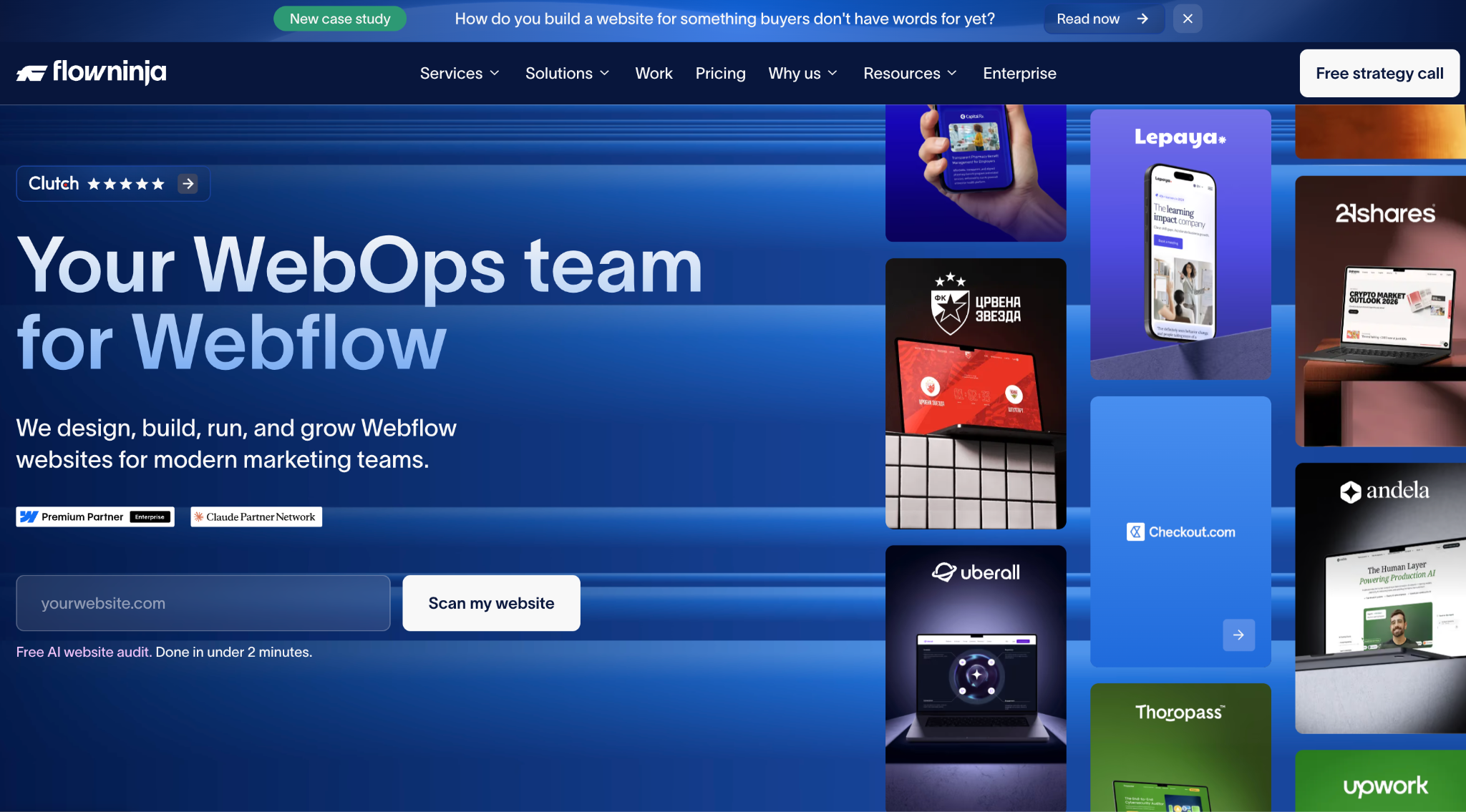
Flow Ninja has been building in Webflow since 2015, one of the earliest agencies on the platform globally. The 65+ person team was named Webflow Enterprise Partner of the Year in 2023 and won the 2025 Webflow Website Experience of the Year.
With 52 verified Clutch reviews and 100+ migrations completed from Drupal, WordPress, AEM, Sitecore, HubSpot, and Contentful, they report 92% SEO retention across that migration portfolio.
Migration expertise: Dedicated Drupal-to-Webflow migration service with an 8-step process: full Drupal audit (content types, Views, modules), architecture mapping, URL and redirect planning, design rebuild, content migration, integration reconnection, QA, and post-launch monitoring.
Best suited for: Enterprise and mid-market organizations needing a WebOps-style ongoing partnership, not just a one-time migration. Strong fit for companies where the website is a core operational asset requiring continuous post-launch iteration.
SEO capabilities: SEO-first migration process with redirect mapping, content verification, metadata transfer, and technical SEO preservation built in from the start. Most clients see rankings stabilize within two to four weeks.
Common Drupal migration challenges (and how experienced agencies solve them)
A Drupal-to-Webflow migration is not moving files from one server to another. It is rebuilding a structured content architecture in a new system while preserving years of accumulated SEO authority and site functionality.
1. Large content libraries
Drupal stores content in a MySQL database via a node-based relational structure. There is no native export path to Webflow. Content must be exported via Drupal's REST API, JSON:API, or CSV, cleaned, reformatted to match Webflow's CMS import schema, and imported in batches. Drupal's Paragraphs module, which allows a single page to be composed of multiple reusable content bundles, is among the hardest content types to migrate.
This typically requires a redesigned content mode. Taxonomy vocabularies must become standalone Webflow Collections, not flattened to option fields. Flattening them breaks filtering logic and internal linking patterns throughout the site.
2. SEO preservation
Drupal's Pathauto module generates URLs like /blog/[category]/[title] and /news/[year]/[month]/[slug]. Webflow's CMS URLs follow /[collection-slug]/[item-slug]. These patterns rarely match without deliberate redirect architecture. Legacy node ID URLs often appear in backlink profiles and need their own 301 redirects.
Metatag module data, including page titles, descriptions, OG tags, and canonical URLs, must be exported to a spreadsheet and imported into Webflow Collection fields before launch. Schema markup must be rebuilt as JSON-LD in Webflow custom code embeds. Missing schema means losing rich result eligibility and AI search citation in Google AI Overviews and Perplexity.
3. Custom features and integrations
Drupal's Views module generates dynamic listing pages with no direct Webflow equivalent. They become Webflow CMS Collection pages, or are replaced with Algolia for complex faceted search. Drupal's Webform module is replaced with Webflow's form builder connected to HubSpot, Salesforce, or Marketo.
Drupal's enterprise RBAC system, with granular roles per content type and multi-stage approval workflows, requires supplementary tooling: a headless CMS layer for approvals, or Memberstack for access control.
How a professional Drupal to Webflow migration works
Here is what a well-run Drupal-to-Webflow migration looks like from start to finish. Webflow design, CMS architecture, SEO, and post-launch monitoring run as integrated workstreams, not sequential phases. This is the benchmark to hold any agency to.
1. Website audit and discovery
A full Screaming Frog crawl exports every URL from the live Drupal site: Pathauto-generated paths, node ID URLs, Views-generated listing pages, and taxonomy term pages. GA4 and Search Console identify high-traffic pages and backlink-equity URLs that cannot break. All active modules are inventoried with a confirmed replacement plan. Content types, field schemas, and taxonomy relationships are fully documented before any build work begins.
2. Migration planning
Every Drupal URL is mapped to its new Webflow destination in a redirect spreadsheet before the build starts. Webflow CMS Collection schemas are fully designed: field types, reference relationships, URL slug structure, and filtering logic all confirmed in writing before build begins. A permission delta report documents every Drupal role and how it will be handled in Webflow. The DNS cutover date is locked with a documented rollback plan.
3. Design and CMS migration
Webflow is set up with a complete design system: typography, color, and spacing defined as variables. Reusable components are built before individual pages. Static pages are rebuilt in Webflow Designer. Drupal content is exported, cleaned, and imported into Webflow CMS Collections in batches. Media assets are downloaded from the Drupal file system, renamed, re-uploaded, and internal links throughout migrated content are updated to new Webflow URLs.
4. SEO migration
301 redirects covering every Drupal URL, including Pathauto paths, taxonomy pages, Views pages, and legacy node IDs, are uploaded to Webflow hosting settings before DNS cutover. Meta titles, descriptions, and canonical tags are transferred from Metatag module export data during the build, not deferred to the end. Schema markup is rebuilt per page type via JSON-LD custom code embeds and validated against Google's Rich Results Test.
5. QA and testing
Every redirect is tested end-to-end. Every form is submitted and confirmed to reach the CRM. PageSpeed Insights runs on at least 10 key pages before launch. Cross-browser testing covers Chrome, Firefox, Safari, and Edge. Analytics events are confirmed live. Nothing goes live without a signed-off QA pass from both agency and client.
6. Launch and post-launch monitoring
DNS cuts over to Webflow. The new XML sitemap is submitted to Google Search Console on launch day and all Drupal-generated sitemaps removed simultaneously. Search Console is monitored daily for 14 days for crawl errors and indexing drops. The Drupal site remains accessible for 30 to 60 days as a fallback. Organic traffic is benchmarked weekly against the pre-migration baseline for 90 days minimum.
How much should you invest in a Drupal to Webflow migration
Migration timelines depend on site size, CMS complexity, integration count, and whether a redesign is in scope. Most B2B SaaS migrations fall in the eight-to-12-week range.
Smaller sites can complete in six to eight weeks. Enterprise Drupal builds with multilingual requirements or deep governance structures typically run 14 to 20+ weeks. Timeline estimates shorter than this for complex Drupal builds usually do not account for content model mapping and integration rebuild time.
How to choose the right Drupal to Webflow agency
Before you shortlist agencies, set your own criteria. These six points separate agencies that can handle a Drupal migration from those that think they can.
- Proven migration experience from Drupal specifically. Ask for case studies from Drupal migrations, not just general CMS migrations. Ask whether they know what Pathauto, Views, and the Paragraphs module are. A portfolio of Wix and Squarespace migrations does not demonstrate readiness for a Drupal build.
- SEO expertise built into the process. Ask whether the redirect map is completed before or after the build starts. Before is correct. After is a serious risk. A vague answer about preserving SEO is a promise without a plan.
- Webflow specialization at a recognized level. Premier Verified and Webflow Enterprise Partner status signal real platform depth. Agencies that do Webflow alongside 10 other platforms rarely have the CMS architecture knowledge Drupal migrations require.
- Technical capability beyond design. Drupal migrations require programmatic content export via REST API or JSON:API, custom code for schema markup, Algolia for site search, and integration rebuilds. Ask specifically how they extract content from Drupal. Any answer referencing an automated migration plugin warrants follow-up questions.
- Transparent deliverables with dates. A competent agency produces a content model map, a redirect map, and a post-launch validation checklist before DNS cutover. If an agency cannot name these deliverables, they likely do not produce them.
- Post-launch support that is included, not quoted separately. Ask what post-launch SEO monitoring covers and for how long. Ask who you contact if rankings drop in the first 30 days. This is where most agency relationships break down after launch.
Questions to ask before hiring a migration agency
Use these on your first call with any agency you are evaluating. The answers reveal more than any proposal will.
- Do you build the redirect map before or after you start building the Webflow site?
- How do you export and transfer Drupal's Metatag module data into Webflow?
- How do you handle Pathauto-generated URLs and legacy /node/ ID URLs in your redirect mapping?
- How do you export content from Drupal: REST API, JSON:API, or CSV? What reformatting does that require?
- How do you test redirects after implementation? What tools do you use?
- What is your realistic timeline for a site of our complexity, and what assumptions are baked into that estimate?
- Who owns the Webflow project after launch: us or the agency?
- Is post-launch SEO monitoring included in the project scope, or billed separately?
- How do you define a successful migration? What metrics do you track post-launch and for how long?
- How do you handle schema markup rebuild in Webflow, and how do you validate it before launch?
Why choose Lil Big Things?
Lil Big Things is built for B2B SaaS startups and scaleups, specifically marketing teams that have outgrown their current site and need to move without hiring an internal web team.
What separates our approach is that we think like marketers. From Webflow design to full builds, every decision is made to ensure that the marketing team uses this independently after launch. This determines how collections are structured, how the Editor interface is set up, and which integrations get built.
Clients like Teachable, Element5, Localyze, and Minoa come back for ongoing work because the systems actually work after handoff.
The ongoing partnership model is Slack-integrated, responsive, and accountable. It keeps us embedded in your workflow for as long as you need it.
Frequently Asked Questions
Most B2B SaaS migrations run eight to 12 weeks. Small sites under 30 pages with minimal CMS can complete in six to eight weeks. Complex Drupal sites with multiple content types, Views-generated pages, and third-party integrations typically take 12 to 16 weeks. Enterprise sites with multilingual requirements or deep governance structures run 14 to 20+ weeks.
Not if it is done correctly. A properly run migration, with a full redirect map built before launch, exact metadata transfer, schema markup rebuilt, and post-launch Search Console monitoring, should preserve rankings. Some short-term fluctuation of five to 10% in the first two to four weeks is normal. A Search Engine Journal analysis of 892 migrations found average recovery took 523 days when migrations go wrong, with 17% never recovering. The agency's process is what determines which outcome you get.
Most of it can be rebuilt or replaced. Drupal's Webform connects to HubSpot or Salesforce via Webflow's native form builder or Zapier. Solr-powered search is replaced with Algolia. Views-generated listing pages become Webflow CMS Collection pages. Complex RBAC governance may require supplementary tools: Memberstack for access control, or a headless CMS layer for multi-stage approval workflows. Auditing all active modules during discovery, before any build begins, is what prevents post-launch functional gaps.
Most B2B SaaS migrations run between $20,000 and $60,000 depending on site size, CMS complexity, and whether a redesign is included. Simple migrations under 30 pages with no redesign start around $10,000 to $20,000. Enterprise migrations with complex content models, integrations, and multilingual requirements run $70,000 to $100,000+. Post-launch retainers for ongoing support typically run $3,000 to $5,000 per month.
Most companies choose to combine the two. It is more efficient than migrating first and redesigning later. A redesign typically adds four to six weeks and meaningful cost. If the current design is working and the main goal is reducing maintenance overhead and giving marketing more control, migration-only is a valid option. If the site is visually outdated or underperforming on conversion, doing both at once is worth the additional investment.
Yes, always. Any URL that changes, including Pathauto-generated paths, taxonomy term pages, Views-generated listing pages, and legacy /node/ ID URLs, needs a 301 redirect to its new Webflow destination. Without them, link equity from years of backlinks is lost and Google treats the new pages as starting from zero. The redirect map is the single most important technical deliverable in any Drupal migration.
Access to Google Search Console and GA4. Admin access to the Drupal backend so the agency can run a module audit and content type inventory. A list of all active third-party integrations. Clarity on whether redesign is in scope. A designated point of contact with authority to sign off on the CMS schema, redirect map, and QA checklist. The more accessible these are at kickoff, the faster the project moves.

_1.svg)