SaaS companies migrate from Joomla to Webflow to escape heavy maintenance, slow loading speeds, and rigid backend editing. Joomla requires constant security patches, plugin management, and developer help for design changes, whereas Webflow offers a managed, visual-first platform where marketing teams can update content safely.
The complexities of the migration can increase based on factors such as expertise of the team handling the migration, current website architecture, the number of pages on the website etc. SEO, rankings, and business continuity are all at stake before a single page goes live.
Choosing the right agency matters more than most companies expect, and with a platform as architecturally complex as Joomla, the margin for error is smaller than it looks.
In this guide, we cover topics related to this migration, including
- Why businesses are moving from Joomla to Webflow in 2026
- The best Joomla-to-Webflow migration agencies, compared on process, SEO capability, and fit
- How to protect your search rankings through the migration
- What to look for when evaluating a migration partner
Why companies move from Joomla to Webflow
1. Reduce maintenance & improve performance
Joomla requires separate updates for its core, its template, and every individual extension. That maintenance cycle never stops. In mid-2026, security researchers at mySites guru disclosed 16 separate vulnerabilities across 16 popular Joomla extensions in a six-week window. One of them allows unauthenticated attackers to upload arbitrary files and execute PHP code directly on the server. It is an active attack surface requiring constant monitoring and patching.
Webflow moves that responsibility entirely off your team. No extensions to patch, no hosting to manage, no security incidents to respond to.
2. Give marketing teams more control
Any layout change on a Joomla site typically requires a developer. Navigation updates, new campaign pages, CMS content restructures, all flow through a ticket queue. That bottleneck compounds as the marketing team grows.
Webflow's visual editor lets non-technical teams publish pages, update CMS content, and launch campaigns without filing a single ticket. Companies on Webflow ship landing pages 5–10x faster than those relying on traditional development cycles. That speed difference compounds over quarters, not just sprints.
3. Build a website that scales
Joomla's share of websites with a known CMS has dropped from 1.4% in July 2025 to 1.2% in July 2026, and the platform continues losing approximately 15,000 active sites annually. The ecosystem, hosting support, extension updates, developer availability, is contracting around it.
Meanwhile, Webflow now matches Joomla's raw CMS adoption at 1.2% of websites with a known CMS, but holds approximately 17% market share in B2B SaaS websites specifically and generated $213M in annual revenue in 2024, a 66% year-on-year increase. The direction of travel on both platforms is not the same.
Comparing Joomla vs Webflow at a glance
The table below is a decision aid, not a feature spec. Each row answers a practical question: does this dimension affect how your team works right now?
Joomla makes sense for organizations with in-house developers, stable content needs, and no pressure to give marketing teams independence. For B2B SaaS and tech companies that need to move fast on the web, Webflow is the more practical choice.
3 best Joomla to Webflow migration agencies
1. Lil Big Things
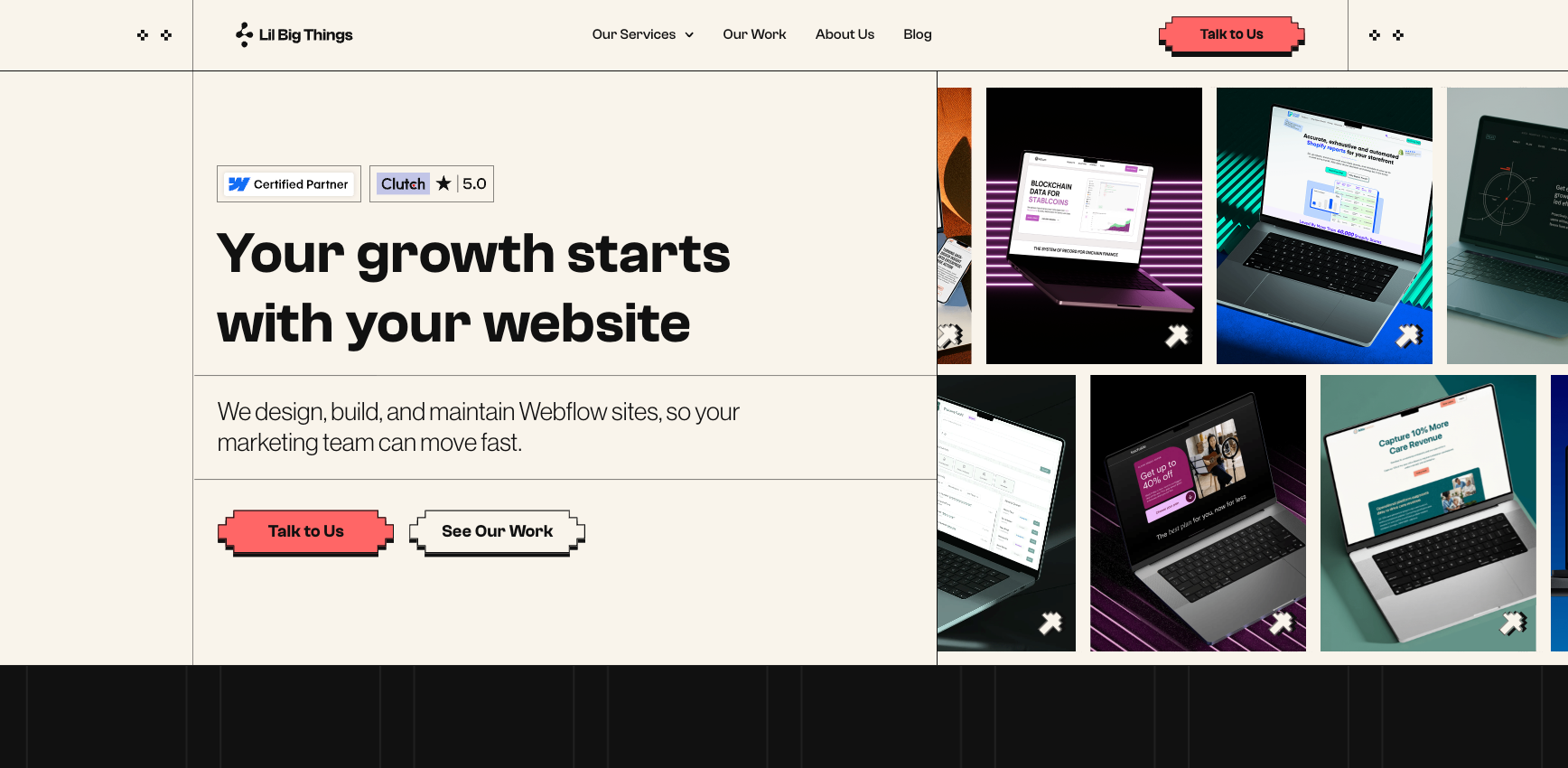
Lil Big Things is a Premier Verified Webflow agency, helping B2B SaaS, MarTech, AI, data, HealthTech, and FinTech companies from Seed through Series C. We have shipped 150+ sites, hold a 95% on-time delivery rate, and maintain a 9.2+ NPS from clients across four continents.
Migration expertise: Full end-to-end migrations from Joomla, WordPress, Wix, Squarespace, and custom legacy builds. Every migration begins with a Screaming Frog crawl of the live Joomla site, surfacing SEF URL variants and extension-managed paths before a single redirect is written. Joomla's lack of a native export tool is handled through a structured content audit and CSV-based CMS import workflow. CMS schema is designed and confirmed in writing before any build work starts.
Best suited for: Marketing teams of two to fifteen at B2B SaaS and tech companies that have inherited a Joomla site they can no longer move fast on, and don't want to hire an internal web team to fix it. Clients include Teachable, Pipecandy, Slintel, Localyze, Allium, Blank Street, Minoa, AllieHealth, Execudent, e6data, Clazar, and Pace.
Notable strengths: Every CMS architecture and publishing workflow decision is made around one question: can the marketing team use this independently after launch? Post-launch support is built into the engagement and is not billed separately. The team operates as an embedded partner, in Slack, in client tools, in the client's timezone.
2. Webyansh
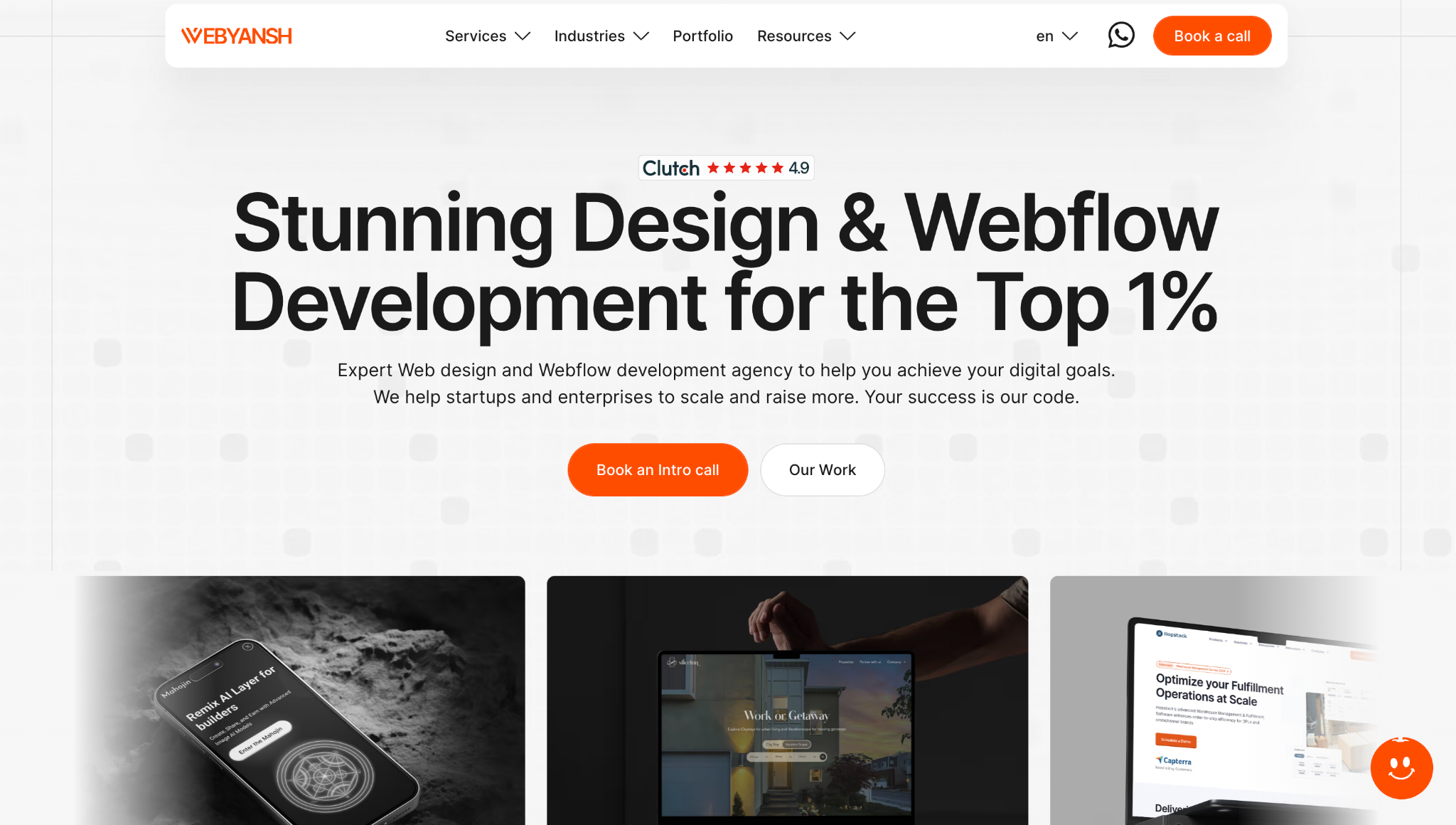
Webyansh is a Webflow development and UI/UX design agency serving B2B SaaS, fintech, AI, and healthcare companies globally. They have shipped 30+ websites for startups and enterprises, completed 20+ migrations with documented 100% SEO preservation, and carry a 95% client satisfaction rate on Clutch.
Migration expertise: Migrates from WordPress, Shopify, Wix, Squarespace, Joomla, and any other platform. Their process covers full page, blog, media, and SEO data transfer, including metadata structure and third-party CRM and analytics integration. Minimum project size is $5,000+, with hourly rates of $100–149. Most projects are delivered in four to eight weeks.
Best suited for: B2B SaaS startups, AI companies, fintech, and healthcare businesses looking for a cost-effective Webflow partner with strong SEO and integration capabilities. Particularly well-matched for companies that want ongoing growth marketing and AI search optimization post-launch, not just a migration handover.
SEO capabilities: Full-service SEO covering technical, on-page, local, GEO (Generative Engine Optimization), and AIO (AI-integrated optimization). One of the few boutique agencies explicitly offering AI search optimization alongside traditional SEO, a relevant differentiator for companies targeting Google AI Overview placements after migration.
Notable strengths: Strategy, UI/UX design, Webflow development, SEO, growth marketing, CRO, integrations, and 24/7 maintenance under one roof. Client reviews consistently highlight responsiveness and on-time delivery. Notable results: Futurense Technologies (27% CVR increase), Aureon Solutions (24.3% CVR increase), GoFIGR (platform migration with improved responsiveness and SEO).
3. Flowout
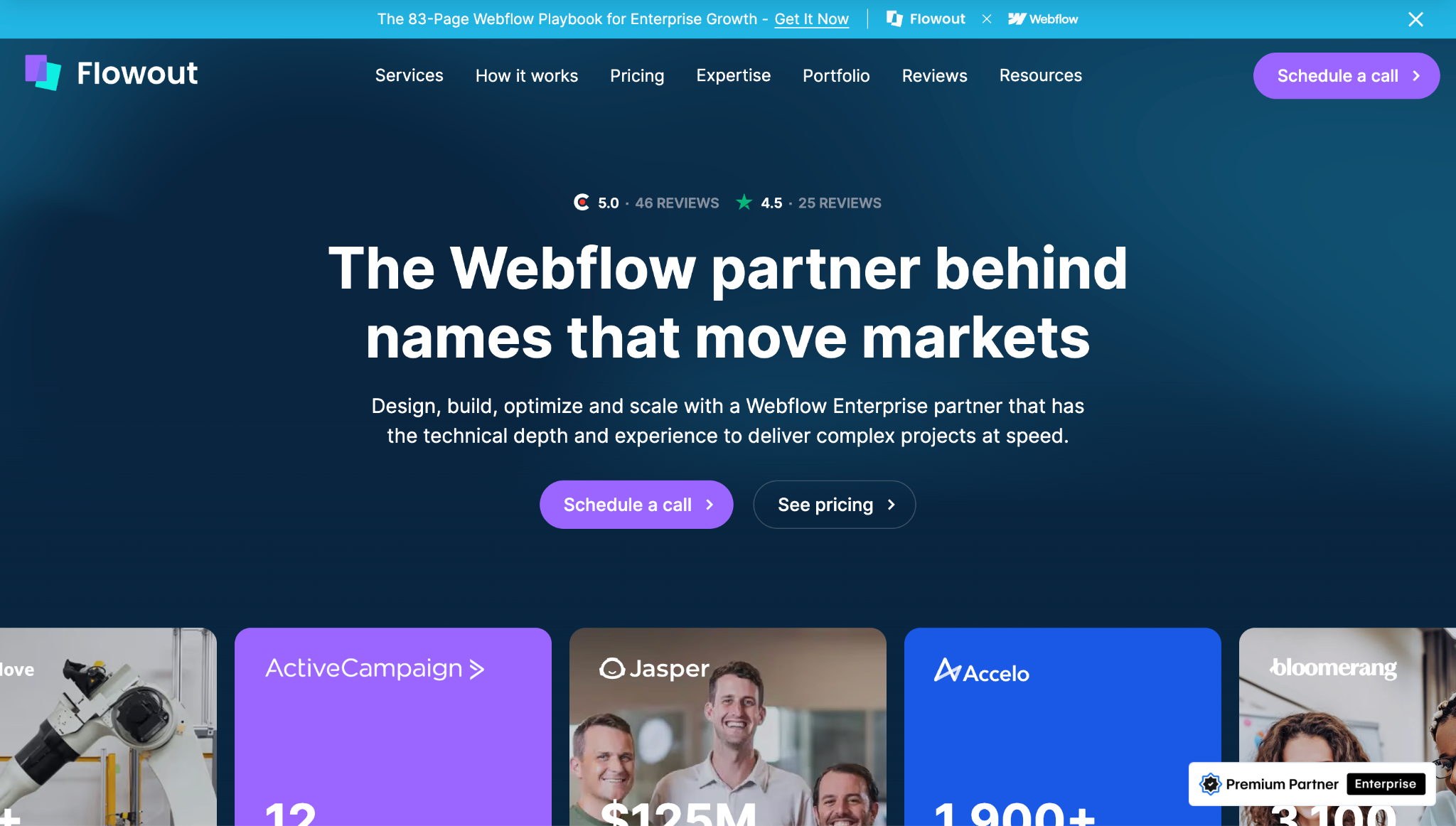
Flowout is a Webflow Premium Partner Enterprise agency headquartered in Slovenia with US operations in Wilmington, DE. They were a finalist for Webflow Agency of the Year in 2024 and have supported 350+ businesses, with clients collectively raising $2B+ in capital. Trusted by Jasper, Riverside.fm, Sendlane, Kajabi, ActiveCampaign, and Sequoia-backed companies. They are one of the first Premium Partner Enterprise agencies globally.
Migration expertise: Dedicated Joomla-to-Webflow migration services The process runs from a free discovery call through dedicated project manager assignment, full content and design migration (pages, blog posts, media), and post-migration support. Custom Joomla functionality, custom code, third-party integrations, unique features, is replicated or rebuilt in Webflow.
Best suited for: SaaS companies, enterprise teams, VC-backed startups, and digital agencies that need ongoing Webflow support beyond a one-time migration. Their subscription-based model suits companies requiring continuous iteration rather than a contained migration. Industries include SaaS, fintech, healthcare, AI, and venture capital.
How a professional Joomla to Webflow migration works
Here is what a well-run Joomla-to-Webflow migration looks like from kickoff to post-launch. Use it as a benchmark when evaluating what agencies include in their process.
1. Website audit & discovery
A full Screaming Frog crawl of the live Joomla site exports every URL, including SEF variants, component-generated paths, and extension-managed routes, with no exclusions. GA4 and Ahrefs identify high-traffic pages and backlink-equity URLs that cannot break under any circumstances. Every active Joomla extension is catalogued: what it does, whether a Webflow equivalent exists, and what the replacement will be.
2. Migration planning
Every Joomla URL is mapped to its Webflow equivalent in a redirect spreadsheet before any build work begins. Webflow CMS collection schemas are designed in writing, field types, reference relationships, URL slugs, filtering logic, and confirmed before development starts. Extension replacement paths are finalized. DNS cutover date is locked with a documented rollback plan in place.
3. Design & CMS migration
The Webflow project is built on a full design system: typography, color, and spacing as Webflow variables. Reusable components are built first, buttons, cards, navigation, CTA modules. Static pages are rebuilt from scratch in Webflow Designer. Joomla article content is cleaned from CSV export, reformatted to match Webflow's import schema, and loaded into Webflow CMS. Images are downloaded from the Joomla server, re-uploaded with accurate alt text, and all internal links are updated to the new Webflow URLs.
4. SEO migration
301 redirects covering every Joomla URL, including SEF and extension-generated variants, are uploaded to Webflow hosting settings. Meta titles, meta descriptions, and canonical tags are transferred exactly per page during the build, not deferred to the final week. Schema markup is rebuilt on every relevant page via custom code embeds. The Webflow staging robots.txt block is verified and removed before launch.
5. QA & testing
Every redirect is tested end-to-end against its expected destination. Every form is submitted and confirmed to reach the CRM. Mobile responsiveness is checked at 320px, 768px, and 1280px. PageSpeed Insights is run on at least ten key pages before launch. Cross-browser testing covers Chrome, Firefox, Safari, and Edge. Nothing goes live without a signed-off QA pass from both agency and client.
6. Launch & post-launch monitoring
DNS cuts over to Webflow. SSL is verified. The new XML sitemap is submitted to Google Search Console on launch day; any Joomla-generated sitemaps are removed the same day. GA4 conversion events are confirmed live. Search Console is monitored daily for the first 14 days, with specific attention to Joomla-derived URL patterns that can surface redirect misses. Organic traffic is benchmarked weekly against pre-migration baseline for at least 90 days.
How much should you invest in a Joomla to Webflow migration?
Typical timeline
- Small sites (under 15 pages, no active CMS): two to three weeks
- Medium sites (15–50 pages, active blog, standard integrations): three to five weeks
- Large sites (50–150 pages, CMS-heavy, multiple extension replacements): six to ten weeks
- Enterprise sites (150+ pages, multilingual, VirtueMart, custom components): three to six months
The biggest timeline variable is how quickly clients review and approve work at each stage. Each week of delayed approvals typically adds one to two weeks to the overall timeline. Joomla sites also require more content preparation time than most clients expect.
The absence of a clean export tool means a manual content audit and CSV reformatting phase before any build can begin, a step comparable migrations off WordPress or Wix don't carry.
What influences cost
How to choose the right Joomla to Webflow agency
These are the criteria that actually matter when evaluating agencies. Bring them to discovery calls, not just agency websites.
- Proven migration experience, not just Webflow experience. Ask for a migration-specific case study. Ask what tool they use to build the redirect map. Ask if they have worked with Joomla's SEF URL structure before. Building a Webflow site from scratch and managing a migration are different disciplines.
- SEO built into the scope, not bolted on. Redirect mapping, metadata transfer, schema rebuild, and Search Console monitoring should all be non-negotiable parts of the engagement. If a quote doesn't include these, ask why.
- Webflow specialization. Agencies that work exclusively in Webflow carry more platform depth than generalists. Premier Verified Partner is the highest Webflow certification tier, a stronger signal than basic certification.
- Technical knowledge of Joomla's specific constraints. Can they explain how they handle Joomla's lack of a direct export tool? Do they know how SEF URL variants and extension-generated paths surface in a live crawl? If an agency talks about "importing" your Joomla site into Webflow, that is a red flag. No import tool exists between the two platforms.
- Transparent process. A good agency can describe exactly what their redirect mapping document looks like, how QA is structured, and what post-launch monitoring covers, before you sign.
- Post-launch support included. Migration doesn't end at launch day. Look for at least two to four weeks of post-launch monitoring as part of the engagement, with the ability to continue as an ongoing Webflow partner.
Questions to ask before hiring a migration agency
Take these into your discovery calls. The answers reveal more than any agency website.
- "How do you build your redirect map, from Joomla's sitemap, or from a live crawl of the site?" (Right answer: live Screaming Frog crawl. Wrong answer: Joomla's built-in export or sitemap.)
- "Do you transfer meta titles, meta descriptions, and schema markup for every page, or only high-priority ones?"
- "How do you handle Joomla's CMS content, specifically the CSV reformatting required to match Webflow's import structure?"
- "How do you design the Webflow CMS schema before the build starts? Can I see an example from a past project?"
- "How do you audit active Joomla extensions and confirm replacements before the project kicks off?"
- "What does your pre-launch QA checklist cover for redirects, specifically Joomla's SEF URL variants?"
- "What is your feedback and approval cycle, and how does delayed client approval affect the timeline?"
- "Who owns the Webflow workspace after the migration, the agency or us?"
- "What post-launch monitoring do you provide, and is it included in the migration fee?"
- "Can you walk me through exactly how you handle Joomla's lack of a direct export to Webflow?" (If the answer involves 'importing the site,' end the call.)
Why choose Lil Big Things?
Lil Big Things is built for B2B SaaS startups and scaleups, specifically marketing teams that have outgrown their current site and need to move without hiring an internal web team.
What separates our approach is that we think like marketers. From Webflow design to full builds, every decision is made to ensure that the marketing team uses this independently after launch. This determines how collections are structured, how the Editor interface is set up, and which integrations get built.
Clients like Teachable, Element5, Localyze, and Minoa come back for ongoing work because the systems actually work after handoff.
The ongoing partnership model is Slack-integrated, responsive, and accountable. It keeps us embedded in your workflow for as long as you need it.
Frequently Asked Questions
Two to three weeks for small sites under 15 pages with no active CMS. Three to five weeks for medium sites with a blog and standard integrations. Six to ten weeks for larger, CMS-heavy sites with extension replacements and custom functionality. Client feedback speed, not build complexity, is the biggest variable in every case.
A well-run migration produces a 10–15% traffic dip in the first two weeks as Google reindexes. Most sites recover within 30 days. A poorly run migration, missing Joomla's SEF URL redirects, dropped metadata, broken indexing, can cause 30–80% loss. Search Engine Journal's analysis of 892 migrations found an average recovery time of 523 days for sites not managed correctly, with 17% never recovering.
Joomla extensions don't transfer to Webflow, every integration must be rebuilt or replaced. Most functionality has a Webflow-native or third-party equivalent: HubSpot, Algolia, Memberstack, Zapier. VirtueMart is the exception. Webflow Ecommerce doesn't replicate its full feature set, so e-commerce-heavy Joomla sites need specific scoping before migration begins.
$3,000–$10,000 for small sites; $10,000–$25,000 for medium sites with a blog and standard integrations; $25,000–$55,000 for larger, CMS-heavy sites. A migration paired with a full redesign adds 30–100% to the investment. Get a fixed-price quote rather than a time-and-materials estimate.
Like-for-like is faster, cheaper, and carries less risk. Redesign once the marketing team is comfortable in Webflow. Running both simultaneously makes it harder to isolate what caused any post-launch traffic changes and pushes timelines out significantly.
Partially. Webflow Ecommerce handles standard product catalogs but does not replicate VirtueMart's full feature set, particularly subscriptions, complex tax configurations, and large catalog management. For stores with significant e-commerce revenue, a Shopify + Webflow hybrid approach is often the better fit. Scope this before the migration starts.
Yes. Joomla's menu-driven URL structure means SEF URL variants and extension-generated paths often differ from what you expect. Even if main pages match, component-generated paths likely won't. Run a live Screaming Frog crawl before assuming any URLs are safe.
Four things: a full list of your active Joomla extensions and what each does; a GA4 baseline of your top traffic pages and their exact current URLs; admin access to Google Search Console; and a decision on like-for-like versus redesign. The cleaner your content and the faster your approval cycle, the faster the migration goes.
_1.svg)