_2.svg)
Companies migrate from Contentful to Webflow to eliminate developer bottlenecks for basic design and copy edits, cut high engineering maintenance costs, and streamline a fragmented headless tech stack into an all-in-one visual platform.
A poorly run migration can wipe out months of organic traffic before anyone identifies what happened. SEO, rankings, and business continuity are all on the line before a single page goes live. A Search Engine Journal analysis of 892 site migrations found that when migrations are mismanaged, the average recovery time is 523 days, and 17% of sites never recover their pre-migration traffic levels at all.
This guide covers:
- Why businesses migrate from Contentful to Webflow
- The best Contentful to Webflow migration agencies, compared on process, SEO capability, and post-launch support
- How to protect your search rankings through the migration
- How to evaluate and choose the right migration partner
It compares the top agencies, walks through what a professional migration looks like step by step, and helps you make the right call with confidence.
Why Companies Move from Contentful to Webflow
1. Reduce Maintenance and Improve Performance
Contentful has no built-in hosting. Teams pay for Contentful to manage content and separately for the infrastructure to serve it. Security depends entirely on the external hosting platform, there is no rollup from Contentful itself.
Webflow handles hosting, SSL, security, and CDN delivery on Amazon Web Services with zero maintenance overhead passed to the team. Performance is a direct benefit too: Webflow sites consistently score 85 to 95 on PageSpeed Insights without additional optimization, a result that varies widely on Contentful-backed sites depending on the frontend stack the original developer chose.
2. Give Marketing Teams More Control
In Contentful, SEO metadata is a developer task. Someone has to create custom fields for meta titles, descriptions, OG tags, and canonical URLs, then map them to the frontend code. If those fields were not set up correctly in the original build, the gaps are invisible until something breaks.
Webflow has native visual SEO tools. Metadata, schema, and sitemaps are accessible without touching code. Marketing teams can publish pages, update CMS content, and run campaigns without waiting on engineering. Teams that make the move typically report shipping landing pages and campaigns five to ten times faster than before.
Contentful vs Webflow at a Glance
This table is a decision aid, not a feature list. Each row answers one business question: is this costing my team right now?
Companies with dedicated in-house development teams, multi-channel content delivery requirements across apps and digital touchpoints, or tightly coupled backend systems may be better served staying on Contentful. Companies where marketing files tickets to update the homepage, where the website is a core growth asset that needs to move fast, or where Contentful costs have grown past what the platform delivers are the clearest candidates for Webflow.
3 Best Contentful to Webflow Migration Agencies
Lil Big Things
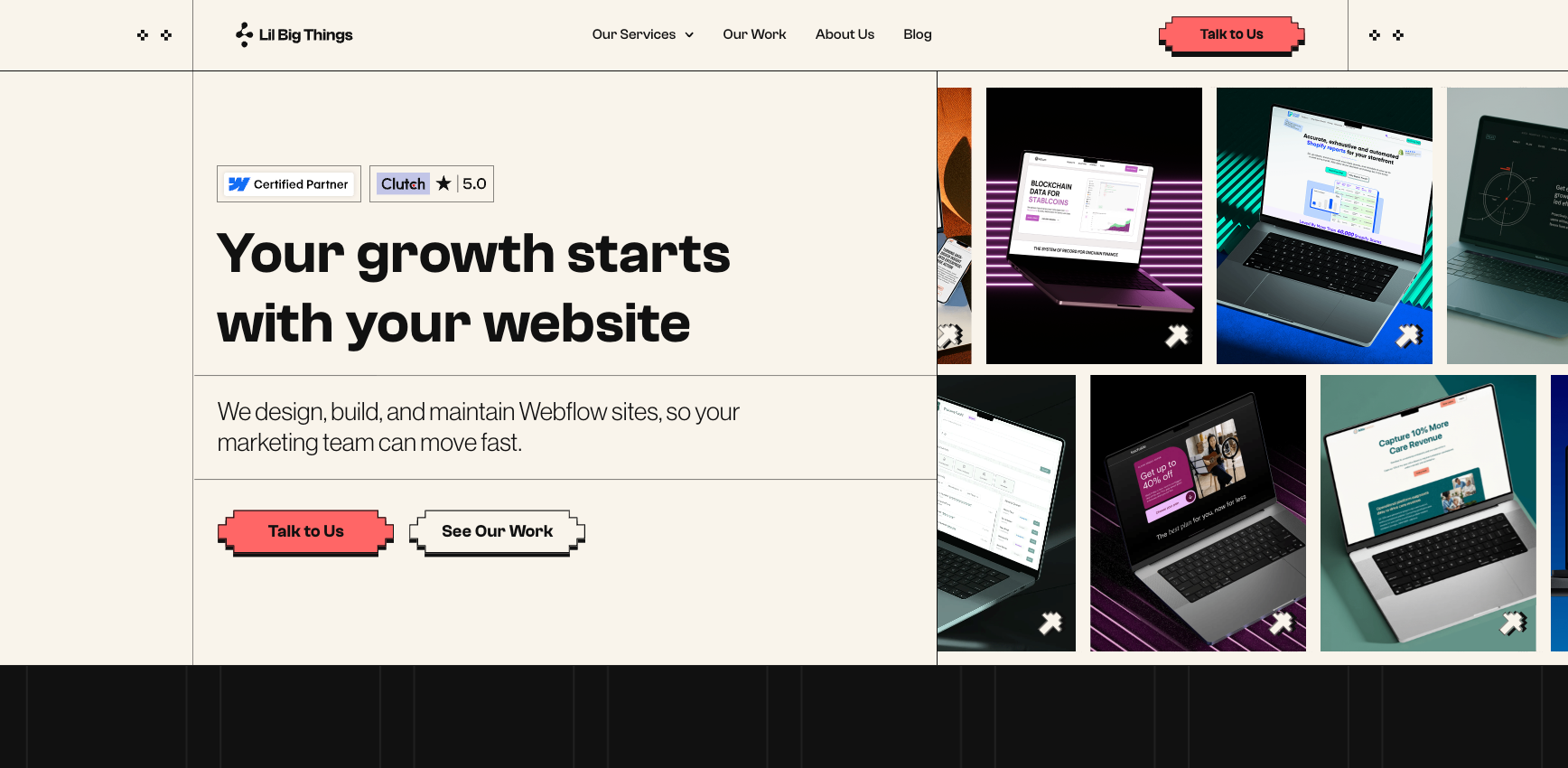
Lil Big Things is a Premier Verified Webflow agency for B2B startups and scaleups. Since 2021, the team has shipped 150+ sites with a 95% on-time delivery rate and a 9.2+ NPS from clients across four continents. Named a Top Agency for Spring 2026 by 50Pros, LBT holds Webflow's highest certification tier.
Best suited for: B2B SaaS, MarTech, AI, Data, HealthTech, and FinTech companies from Seed through Series C with marketing teams of two to fifteen. Companies that need to move fast and do not want to manage an internal web team just to keep the site current after launch.
Migration expertise: End-to-end Contentful migrations covering site audit, CMS schema design (mapping Contentful content types and rich text fields to Webflow Collections), redirect mapping, metadata transfer, integration wiring (HubSpot, GA4, Salesforce, Marketo), and post-launch SEO monitoring. Content is exported via Contentful's Content Delivery API, cleaned, reformatted, and imported into Webflow in batches, the right way to handle a platform with no direct export path.
SEO capabilities: Full Screaming Frog crawl before the build starts. A metadata audit of the existing Contentful build runs before migration begins to surface fields that were missing or inconsistently set up by the original developer. Exact metadata transfer for every page. Schema rebuilt via custom code embeds. Google Search Console monitored daily for 14 days post-launch. SEO is baked into the process from day one.
Notable strengths: Every CMS architecture decision is built around one question: can the marketing team operate this site independently after launch? The embedded team model means LBT is in Slack, working in client tools, aligned to client timelines. Post-launch support is built in, not billed separately. The Pipecandy build is a documented example of their full-process approach, worth reviewing before any agency call.
2. Creative Corner Studio
Creative Corner Studio is a Webflow Premium Enterprise Partner founded in 2019, with offices in Sofia and Amsterdam. Co-founder Miroslav Ivanov has personally led 350+ Webflow projects and reviews every new project before kickoff. Their 50+ in-house team covers design, development, SEO, AEO, and CRO under one roof.
Best suited for: B2B companies in Tech, SaaS, Healthcare, Consulting, and Fintech, from 5-page startup sites to 1,000+ page enterprise platforms. Strong fit for companies that want design, development, and SEO handled in a single engagement rather than across multiple vendors.
Migration expertise: Full-service CMS migrations from Contentful, WordPress, Wix, and Squarespace to Webflow. They migrated Juma's 216+ pages from WordPress to Webflow in 40 days with zero SEO loss, including 30+ reusable components. The Testlio migration moved 823 pages to Webflow Enterprise in a 14-week rebuild, preserving approximately 200,000 monthly visits and full SEO performance.
SEO capabilities: Zero SEO loss methodology built into every migration. Post-migration, they offer AI Search Optimization (AEO/GEO), structured work to get B2B brands cited in ChatGPT, Perplexity, Gemini, and Google AI Overviews. One documented post-migration result: a 70% conversion rate increase for a client after launch.
3. Foursets
Foursets is a Webflow Premium Partner founded in 2021, based in Warsaw, Poland. Clutch Champion 2024. Awwwards Honorable Mention twice over. They work with B2B companies across 25+ countries through three in-house departments: Design, Development, and SEO. Contentful-to-Webflow is a named migration path on their services page.
Best suited for: B2B companies wanting a design-led migration with integrated SEO and AEO (AI Engine Optimization). A particularly strong fit for companies where the Contentful site is also visually outdated and needs a redesign alongside the migration, design is a first-class output, not an afterthought.
Migration expertise: Seven-step migration process: consultation and planning, Figma design recreation before a single page is built, content and data mapping, website migration, custom feature integration, testing and QA, then launch with ongoing maintenance. Documented results include a +33% web engagement increase for AutoTrader post-migration and a 30-page Obligo migration completed in three weeks.
SEO capabilities: SEO protection built into every migration, with post-migration SEO and AEO available as an ongoing service. Documented client results include 300% organic traffic growth and 35% annual revenue increase for migrated sites. Their "No-Risk Project" model lets clients see a month of real progress before paying anything.
How a Professional Contentful to Webflow Migration Works
Here is what a well-run migration looks like from start to finish. Design, CMS architecture, SEO, and post-launch monitoring run as integrated workstreams, not sequential phases. This is the benchmark to hold any agency to.
1. Website Audit and Discovery
A full Screaming Frog crawl exports every URL from the live Contentful-based site: page URLs, blog posts, landing pages, and any dynamically generated routes from the frontend framework. GA4 and Search Console identify high-traffic pages and URLs carrying backlink equity that cannot break under any circumstances.
Every Contentful content type, field schema, and reference relationship is fully documented before any build work begins. All active integrations are catalogued with a confirmed rebuild path agreed before the project scope is locked.
2. Migration Planning
Every old URL maps to its new Webflow equivalent in a redirect spreadsheet before the build starts. This is non-negotiable. Webflow CMS Collection schemas are designed in full, field types, reference relationships, URL slug structure, and filtering logic, all confirmed in writing before a single page is built. Integration rebuild paths are scoped and agreed. A DNS cutover date is set with a documented rollback plan in place from day one.
3. Design and CMS Migration
Webflow is set up with a complete design system: typography, color, and spacing defined as variables for consistency across every page. Reusable components are built before individual pages start. Contentful content is exported via the Content Delivery API, cleaned, reformatted to Webflow's CSV import structure, and imported into CMS Collections in batches. Images are downloaded from Contentful's CDN, re-uploaded to Webflow's Asset Manager, and internal links throughout migrated content are updated to point to new Webflow URLs.
4. SEO Migration
301 redirects covering every Contentful URL are uploaded to Webflow hosting settings before DNS cutover. Meta titles, descriptions, and canonical tags are transferred as pages are built, not deferred to the end of the project. Schema markup is rebuilt per page type as JSON-LD via custom code embeds and validated against Google's Rich Results Test. The internal link graph is updated throughout migrated CMS content. robots.txt is configured and validated before cutover so Webflow staging stops blocking crawlers before the domain switch.
5. QA and Testing
Every redirect is tested end-to-end against its expected destination. Every form is submitted and confirmed to reach the CRM. PageSpeed Insights runs on at least ten key pages before launch. Cross-browser testing covers Chrome, Firefox, Safari, and Edge. Analytics events are confirmed live. Nothing goes live without a signed-off QA pass from both agency and client.
6. Launch and Post-launch Monitoring
DNS cuts over to Webflow. The new XML sitemap is submitted to Google Search Console on launch day and the old sitemap removed at the same time. GA4 conversion events are confirmed live. Search Console is monitored daily for 14 days for crawl errors and coverage drops. Organic traffic is benchmarked weekly against the pre-migration baseline for 90 days. The Contentful-based site stays accessible for 30 to 60 days as a fallback in case anything needs to be rolled back.
What Happens to Your SEO During Migration?
Common SEO Risks
Three mistakes cause 95% of migration-related ranking losses: broken redirects, content gaps, and indexing problems. Broken redirects are the most common cause.
For Contentful migrations specifically, the risks include:
- Metadata that was never properly set up in the original Contentful build, surfacing as gaps only during a pre-migration audit
- URL structure differences between Contentful's frontend and Webflow's CMS collection paths, with no 301 redirects to bridge them
- Rich text content importing with formatting issues, broken links, or missing assets that create indexing problems at scale
- Webflow's staging robots.txt left blocking crawlers past DNS cutover, de-indexing the entire site on launch day
- Schema markup not rebuilt in Webflow custom code, eliminating rich result eligibility and AI search citation simultaneously
How Agencies Protect Rankings
Agencies that protect rankings treat SEO as a parallel workstream from day one, not a post-build checklist. The redirect map is built before a single Webflow page exists. A metadata audit of the Contentful build runs before migration starts, catching field gaps that would otherwise go live as missing metadata. Metadata is transferred exactly for every page during the build. Schema is rebuilt per page type and validated via Google's Rich Results Test. robots.txt is updated before DNS cutover. The new XML sitemap is submitted to Search Console on launch day with the old sitemap removed at the same time. Search Console is monitored daily for the first 14 days. Miss any one of these steps and rankings follow.
Recovery Timeline
A well-executed migration produces a 10 to 15% traffic dip in the first two weeks as Google reindexes. Most sites recover to their pre-migration baseline within 30 days when redirects and metadata were handled correctly. Full recovery, including any new ranking gains from improved Webflow performance, typically takes 60 to 90 days. If major issues exist: redirects broken at scale, metadata lost, schema deleted, recovery for competitive keywords can stretch three to six months. The agency's process before launch determines which outcome you get.
Contentful to Webflow Migration Timeline and Investment
Typical Timeline
Migration timelines depend on site size, CMS complexity, integration count, and whether a redesign is in scope. Contentful migrations consistently take longer than migrations from simpler platforms. There is no direct export path, content requires API extraction, cleaning, and reformatting before Webflow import can begin. Undocumented custom integrations, common in Contentful builds where developers worked without clear handover documentation, frequently surface during the audit and add scope that was not anticipated at kickoff.
The variable most agencies do not name upfront: client approval speed. Each week of delayed reviews typically adds one to two weeks to the overall timeline.
What Influences Cost
Page count is the primary driver. CMS complexity matters, the number of Contentful content types in use, whether rich text embedded entries are involved, and the extent of reference relationships all increase scope. Custom integrations each carry their own rebuild time. Redesign is the biggest single variable: migration combined with a full visual redesign adds 30 to 100% to the investment. Multilingual Contentful sites are a separate category, Contentful's localization model has no direct Webflow equivalent, and both Webflow Localization and third-party tools like Weglot add build time and ongoing platform cost.
How to Choose the Right Contentful to Webflow Agency
Before you shortlist agencies, set your own criteria. These six points separate agencies that can run a Contentful migration from those that think they can.
- Proven migration experience from Contentful specifically. Ask for case studies from Contentful migrations, not just general CMS work. Ask whether they know how Contentful exports content, what the rich text embedded entry problem is, and how they handle assets that do not export with the content JSON. A portfolio of Wix and Squarespace migrations does not demonstrate readiness for Contentful's architecture.
- SEO expertise built into the process. Ask whether the redirect map is completed before or after the build starts. Before is correct. After is a serious risk. Ask specifically about the Contentful metadata audit, many Contentful builds have incomplete or missing metadata fields that must be surfaced and fixed before migration begins. A vague answer about preserving SEO is a promise without a plan.
- Webflow specialization at a recognized level. Premier Verified and Webflow Enterprise Partner status signal real platform depth. Agencies doing Webflow alongside ten other platforms rarely carry the CMS architecture knowledge that Contentful migrations require.
- Technical capability beyond design. Contentful migrations require API-based content extraction, custom code for schema markup, integration rebuilds, and batch content import processes. Ask specifically how they extract content from Contentful. Any answer referencing an automated migration plugin warrants follow-up questions, no such tool handles nested Contentful content structures reliably.
- Transparent process with named deliverables. A competent agency produces a content model map, a redirect map, and a post-launch validation checklist before DNS cutover. If an agency cannot name these deliverables, they likely do not produce them.
- Post-launch support included, not quoted separately. Ask what post-launch SEO monitoring covers and for how long. Ask who you contact if rankings drop in the first 30 days. This is where most agency relationships break down after launch.
Questions to Ask Before Hiring a Migration Agency
Use these on your first call with any agency you are evaluating. The answers reveal more than any proposal or case study will.
- Do you build the redirect map before or after you start building the Webflow site? (Right answer: before. Any other answer is a red flag.)
- How do you export content from Contentful, via the Content Delivery API, and what reformatting does that require before Webflow import? (Right answer: names the API and acknowledges the reformatting work involved.)
- How do you handle rich text fields with embedded entries and inline assets from Contentful? (Right answer: names this as a specific challenge and describes their approach.)
- Do you run a metadata audit of the Contentful build before starting, and what happens if fields were missing or inconsistently set up by the original developer? (Right answer: yes, with a documented approach to closing gaps before migration begins.)
- When in the project do you transfer meta titles, descriptions, schema, and canonical tags? (Right answer: during the build, not deferred to the end.)
- What does your QA checklist cover, specifically redirect testing, Core Web Vitals, and form submissions to the CRM? (Right answer: names all three with specifics.)
- What is the realistic timeline for a site of our complexity, and what assumptions are baked into that estimate? (Probe: what happens if undocumented integrations surface during the audit?)
- Who owns the Webflow workspace after the migration completes, us or the agency? (Right answer: the client. Always.)
- What post-launch SEO monitoring do you provide, and is it included in the project fee or billed separately? (Right answer: minimum 14 days of daily Search Console monitoring, included.)
- How do you define a successful migration, and what metrics do you track post-launch and for how long? (Right answer: organic traffic against the pre-migration baseline for at least 90 days, with specific metrics named.)
Why Choose Lil Big Things?
Lil Big Things is built for B2B SaaS startups and scaleups, specifically marketing teams that have outgrown their current site and need to move without hiring an internal web team.
What separates our approach is that we think like marketers. From Webflow design to full builds, every decision is made to ensure that the marketing team uses this independently after launch. This determines how collections are structured, how the Editor interface is set up, and which integrations get built.
Clients like Teachable, Element5, Localyze, and Minoa come back for ongoing work because the systems actually work after handoff.
The ongoing partnership model is Slack-integrated, responsive, and accountable. It keeps us embedded in your workflow for as long as you need it.
Frequently Asked Questions
Most B2B SaaS migrations run four to eight weeks for medium sites. Small sites under 30 pages with no CMS can complete in two to four weeks. Complex Contentful builds with multiple content types, nested references, and custom integrations typically run eight to twelve weeks or longer. The biggest variable is usually client approval speed, not build complexity, each week of delayed reviews adds one to two weeks to the timeline.
Not if it is done correctly. A properly run migration, full redirect map built before launch, a metadata audit of the Contentful build, exact metadata transfer for every page, schema rebuilt in Webflow custom code, and Search Console monitored daily post-launch, preserves rankings. Some fluctuation of 10 to 15% in the first two weeks is normal as Google reindexes. A Search Engine Journal analysis of 892 migrations found the average recovery time is 523 days when migrations go wrong, with 17% of sites never recovering. The agency's process is what determines which outcome you get.
Most of it can be rebuilt. Forms connected to HubSpot, Salesforce, or Marketo rebuild via Webflow's native form builder or Zapier. Algolia site search can be reconnected to Webflow. Complex authenticated user flows may require supplementary tools like Memberstack. Every integration must be catalogued and given a confirmed rebuild path during discovery, before the build begins. Post-launch integration surprises are the most expensive kind.
Most B2B SaaS migrations run $20,000 to $60,000 depending on site size, CMS complexity, and whether a redesign is in scope. Small sites start around $10,000 to $20,000. Enterprise migrations with multilingual requirements, custom integrations, and large content libraries run $70,000 to $100,000 or more. A migration combined with a full visual redesign adds 30 to 100% to the investment. Get a fixed-price quote rather than a time-and-materials estimate wherever possible.
Most companies combine both, it is more efficient than migrating first and redesigning later. A redesign typically adds 30 to 100% to the project investment. If the current design works and the goal is simply removing developer dependency, migration-only is a valid and lower-cost approach. One planning note: doing both simultaneously makes it harder to isolate what caused any post-launch traffic changes, so the agency needs a clean pre-migration baseline to reference.
Yes, with redesign. Webflow's CMS has a simpler structure than Contentful. Deeply nested references and embedded rich text entries cannot be directly mapped field-for-field, they must be re-architected into Webflow Collections. This is expected scope in a professional migration, not a workaround. Any agency that does not mention this when you ask about content migration has not done it before.
Yes, always. Contentful and Webflow CMS use different URL patterns for dynamic collection pages. Even when main pages match, blog posts, category pages, and collection paths often will not. A Screaming Frog crawl of the live site before assuming any URL is safe is non-negotiable. A missed redirect is a permanently lost backlink, the equity does not come back.
Four things: admin access to Google Search Console and GA4 for pre-migration traffic benchmarks, login credentials for every third-party integration currently connected to the Contentful build, clarity on whether a redesign is in scope alongside the migration, and a named internal contact with authority to sign off on the CMS schema, redirect map, and QA checklist. The cleaner the access and the faster the approvals, the faster the migration goes.
_1.svg)